Digital Studio India · October 2026 · Pages 56–59
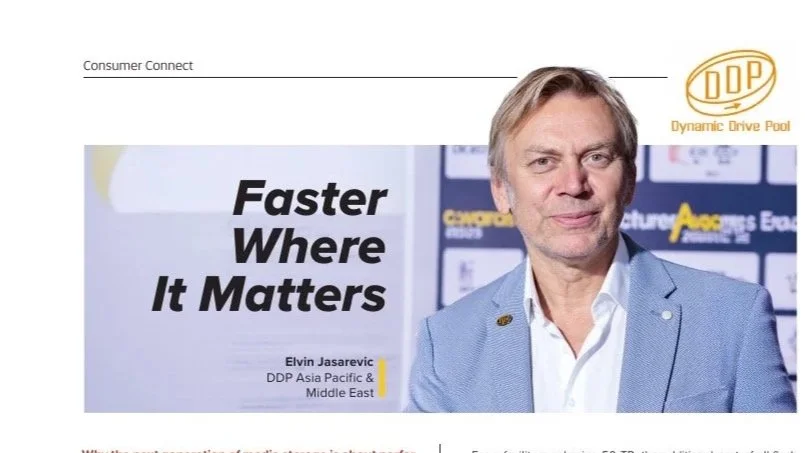
By Elvin Jasarevic
Read or download the full four-page PDF
Reproduced from the October 2026 issue. Event references and product descriptions reflect the article as published.
Why the next generation of media storage is about performance, intelligent placement and freedom of choice
After IBC 2026, one thing was very clear in our conversations with broadcasters, post-production companies and system integrators: performance still matters more than ever. Faster shared storage is not simply about producing an impressive benchmark number. More bandwidth means more simultaneous editors, more high-resolution streams, faster ingest, faster rendering and delivery, less waiting and, ultimately, more work completed in the same production day.
This has always been one of DDP's strongest advantages. Dynamic Drive Pool was designed around sustained high-performance shared storage, from very fast hybrid systems through to all-NVMe platforms such as DDP10EF. But customers are now asking a second question as well: How do we get maximum performance where we need it without paying for maximum performance on every terabyte?
That is where the storage discussion becomes more interesting. 4K production is now routine in many environments, while 6K, 8K, RAW, high-frame-rate and uncompressed workflows continue to increase bandwidth requirements. AI tools are analysing, transcribing, indexing and generating more media, while increasing numbers of users and applications are accessing the same storage simultaneously. The challenge is therefore no longer simply choosing between HDD, SSD or NVMe.
It is combining very high performance with intelligent data placement, capacity and cost. The more useful question becomes: Which data needs maximum performance right now — and where should it live?
AI is changing storage economics
The enormous investment in AI infrastructure and hyperscale data centres is placing new pressure on enterprise storage supply. This matters to Media & Entertainment because broadcasters and production companies are competing for many of the same HDD and flash resources being consumed by large data-centre projects. For a facility purchasing 50 TB, the additional cost of all-flash storage may be relatively manageable.
At 500 TB, one petabyte or several petabytes, the economics change dramatically. Technically, putting everything on NVMe would be an excellent solution. DDP itself builds extremely high-performance all-NVMe systems.
But does every completed programme, unused camera original, archive project and nearline file really need maximum NVMe performance every second of the day? Usually not.
Faster where it actually matters
Most media organisations store considerably more material than they are actively editing. A broadcaster may keep years of programmes online. A post-production company may have hundreds of projects immediately available.
But only a fraction of that content forms the active working set at any particular moment. That is why SSD caching remains so effective. A relatively small group of enterprise SSDs can provide a high-performance working layer for a much larger HDD environment.
Take eight enterprise SSDs as a practical example. Depending on the SSD model, RAID configuration, codec, network and number of simultaneous users, those drives can provide several gigabytes per second of high-speed performance. Those SSDs are not simply making eight HDDs faster.
They can accelerate the active media being requested from a much larger storage pool. If a facility has 1 PB online but only part of that content is in active production, purchasing 1 PB of flash simply to accelerate the active portion may not be the most intelligent use of the storage budget. Why put an entire petabyte on flash when only a fraction of the data needs flash performance?
DDP goes beyond caching
Caching, however, is only part of DDP's approach. At the heart of every DDP system is A/V FS, DDP's shared file system. A/V FS is built into every DDP storage system, while Data Locations allow administrators to directly control where particular 57DIGITAL STUDIO | October 2026www.digitalstudioindia.com projects and folders reside.
A demanding finishing project can live on NVMe. An active editorial project can reside on SSD. Completed productions, camera originals and large media libraries can remain online on high-capacity HDD.
All of them can remain part of the same DDP environment. This distinction is important. SSD caching provides transparent acceleration, while Data Locations provide deliberate placement.
DDP Folder Volumes then keep the underlying complexity away from the editor. A Folder Volume appears as familiar shared storage: a normal drive on Windows or a mounted volume on macOS and Linux. The editor does not need to know whether the project underneath is physically on NVMe, SSD or HDD.
Data can also be moved or mirrored between Data Locations as the requirements of a production change. Storage can therefore follow the production lifecycle rather than forcing production to follow the storage.
One platform, three storage technologies
There is no argument that NVMe is faster than HDD. The question is whether the highest possible performance is required for every file. At the extreme-performance end, the all-NVMe DDP10EF provides up to 40 GB/s read and 24 GB/s write performance.
For finishing, RAW, high-resolution work, VFX and highly concurrent environments, that level of performance can translate directly into productivity. A faster storage system can support more streams and more simultaneous users. Editors spend less time waiting for media, renders and transfers.
Facilities can handle more work with the same infrastructure and complete more jobs in the same working day. That is why performance remains such an important DDP message. SSD is extremely effective for active collaborative production and acceleration, while HDD remains difficult to beat economically when hundreds of terabytes or several petabytes need to remain online.
DDP therefore lets each technology play to its strengths: NVMe for extreme performance. SSD for active production and acceleration. HDD for large-scale capacity.
Most importantly, they do not need to become three isolated storage systems.
From NEXIS to a more open workflow
Another change was very visible at IBC. For many years, a large Media Composer environment almost automatically led to a discussion about Avid NEXIS. NEXIS remains an established and mature platform, particularly in long-standing Avid editorial environments.
But customers are increasingly asking whether their storage investment should also determine which editing software they use several years from now. At IBC we tested DDP alongside NEXIS using both Mac and Windows workstations. That reflects the kind of migration scenario customers are increasingly discussing with us.
More organisations are evaluating DDP as a direct replacement for existing NEXIS storage, particularly where they want greater flexibility in capacity, performance and application choice. The editing-software environment is changing as well. Media Composer remains very important, particularly where established Avid collaboration, automation and operator familiarity matter.
But licensing cost is becoming a larger part of the infrastructure calculation, while alternatives such as DaVinci Resolve and Final Cut Pro have become extremely capable. Resolve now combines editing, colour, audio, VFX and finishing within one environment. Final Cut Pro remains an important option for Mac-based production, while Adobe Premiere continues to be widely used across broadcast, corporate, online and commercial production.
This reinforces one of DDP's core principles: Storage should not decide which NLE the customer has to use.
Storage that survives software changes
A shared-storage platform may remain in service considerably longer than the editing software purchased at the same time. During the life of that storage, a customer may change editing applications several times. A facility could use Media Composer for long-form editorial, Resolve for finishing, Premiere in another department, Final Cut Pro for another team and Pro Tools for audio.
DDP is designed to sit underneath those workflows rather than lock the customer into one application ecosystem. That provides an important form of investment protection. Changing creative software should not automatically mean changing the storage infrastructure.
What about MAM?
Another question we hear frequently is: “Where is the DDP MAM?” DDP is not positioned as a traditional standalone enterprise MAM, but it already provides important workflow and access-management functions at the storage level. Administrators can control access at both user and workstation level, with permissions including read only, read/write/delete, Drop Box and no access. This allows different users, departments and systems to work from the same shared storage while maintaining clear control over who can see, modify, delete or deliver particular media.
For some broadcasters, a dedicated enterprise MAM remains essential. Rights management, approvals, newsroom integration, long-term metadata governance, archive management and organisation-wide automation can absolutely justify a specialised MAM. DDP can provide the high-performance shared-storage foundation underneath that environment, while handling practical access and permission management within the storage layer.
But the software landscape is changing quickly. Modern creative applications increasingly include sophisticated media-search, transcription and AI-analysis tools themselves. DaVinci Resolve 21 includes AI IntelliSearch, allowing editors to search visual content and objects, dialogue transcripts, metadata and individual faces directly from the Media Pool.
Final Cut Pro now includes Visual Search and Transcript Search, helping editors locate objects and actions in footage as well as spoken words and phrases. Adobe Premiere includes AI-powered Media Intelligence, allowing editors to search footage using visual descriptions, spoken dialogue, audio, text and embedded metadata. This does not mean enterprise MAM is disappearing.
It means customers now have more choice. A large broadcaster can integrate the specialised MAM it needs. A smaller or mid-sized production company may find that the combination of DDP permissions, Folder Volumes and storage management, together with increasingly powerful search and AI tools inside Resolve, Final Cut Pro or Premiere, already covers much of its everyday operational requirement.
DDP therefore concentrates on what the storage platform should do exceptionally well: Store, share, protect, control access and deliver media quickly and reliably to whichever application the customer chooses.
IP SAN performance over familiar Ethernet
Fast drives alone do not create fast shared storage. The data still has to reach the editor. DDP is an Ethernet-based IP SAN, rather than simply conventional NAS.
Customers can use familiar Ethernet switches, cabling and network adapters while gaining a shared-storage architecture designed around the sustained throughput required by professional media. This becomes increasingly important as facilities move from HD and 4K into 6K and 8K production and as the number of simultaneous clients increases. Higher storage bandwidth then becomes real production capacity: more users, more streams and more work being completed.
High performance does not automatically require moving the 59DIGITAL STUDIO | October 2026www.digitalstudioindia.com entire facility to a separate Fibre Channel infrastructure.
High Availability at enterprise scale
As storage becomes central to ingest, editorial, graphics, audio, finishing and playout, availability becomes just as important as speed. DDP High Availability is separate from A/V FS. A/V FS remains built into every DDP storage system, while HA provides the additional redundancy and failover required by organisations where storage interruption is unacceptable.
A recent Middle East installation demonstrates how far this architecture can scale. The system approaches 2.9 PB, combining 24 NVMe drives with approximately 90 HDDs and providing around 25 GB/s of read performance. The project was won through a competitive tender involving major international storage vendors.
At this scale, hybrid architecture becomes more than an interesting technical option. It becomes an economic advantage. There is little reason to pay NVMe prices for several petabytes when much of that media simply needs to remain online, protected and immediately accessible.
But when maximum performance is required, DDP can provide it. That combination of speed, scalability and intelligent use of storage technology is the important point.
Cloud is useful — but production storage is different
Cloud was another major subject at IBC. DDP can export data to Backblaze and S3-compatible object storage, allowing cloud to become part of backup, archive, off-site protection and distribution workflows. Cloud is extremely useful, but active production has different requirements.
Editors need predictable throughput, low latency and immediate access to very large files. Continuously moving high-resolution media between remote object storage and many editing stations can introduce bandwidth, latency and transfer-cost considerations. For valuable or sensitive productions, many organisations also prefer active media to remain under infrastructure they directly control.
The answer does not need to be cloud or on-premise. It can be both. Use high-performance DDP storage for active production, economical online capacity for less demanding media, and cloud where off-site scale, protection and accessibility provide a real advantage.
Again, the principle is the same: Put the right data in the right place.
From IBC to Broadcast India
DDP's approach has already received significant industry recognition. In 2025, Dynamic Drive Pool won Best in Content Storage at the BroadcastPro ME Manufacturer Awards during CABSAT Dubai, followed later that year by recognition for Content Storage and Archiving at Broadcast India in Mumbai. Those awards reflect both sides of the DDP philosophy.
DDP can provide extreme all-NVMe performance where it is required, while also combining NVMe, SSD and HDD intelligently when capacity, performance and economics all matter at the same time. Following IBC 2026, visitors can see DDP again at Broadcast India Show 2026, where DDP will exhibit together with Cinthamani Computer at Booth B02.
Performance with freedom to change
The media industry has spent many years looking for one technology that solves everything. Everything should be flash. Everything should be cloud.
Everything should be NAS. Everything should come from one vendor. Real production environments are more complicated.
DDP's approach is different. Performance comes first because faster storage means more streams, more simultaneous users, less waiting and ultimately more work completed. But performance also needs to be used intelligently.
Give customers the freedom to use NVMe, SSD and HDD together. Let them continue using Media Composer or introduce Resolve, Final Cut Pro, Premiere Pro or another application. Allow them to integrate a dedicated MAM where it adds value without forcing one into every installation.
Use cloud where cloud makes sense while keeping demanding production workflows close to the editors. The objective is not only to deliver the highest possible performance, but to make that performance available where it creates the greatest production value. For DDP, performance is not just a benchmark.
It means more bandwidth, more streams, more users and more work completed. The next step is making sure that performance is applied to the right data, on the right storage, at the right time. That is what DDP was designed to do.
High-performance shared storage without the lock-in — and with the freedom to change.
Digital Studio India · October 2026
By Elvin Jasarevic
Read or download the full four-page PDF
Reproduced from the October 2026 issue. Event references and product descriptions reflect the article as published.

Why the next generation of media storage is about performance, intelligent placement and freedom of choice
After IBC 2026, one thing was very clear in our conversations with broadcasters, post-production companies and system integrators: performance still matters more than ever. Faster shared storage is not simply about producing an impressive benchmark number. More bandwidth means more simultaneous editors, more high-resolution streams, faster ingest, faster rendering and delivery, less waiting and, ultimately, more work completed in the same production day.
This has always been one of DDP's strongest advantages. Dynamic Drive Pool was designed around sustained high-performance shared storage, from very fast hybrid systems through to all-NVMe platforms such as DDP10EF. But customers are now asking a second question as well: How do we get maximum performance where we need it without paying for maximum performance on every terabyte?
That is where the storage discussion becomes more interesting. 4K production is now routine in many environments, while 6K, 8K, RAW, high-frame-rate and uncompressed workflows continue to increase bandwidth requirements. AI tools are analysing, transcribing, indexing and generating more media, while increasing numbers of users and applications are accessing the same storage simultaneously. The challenge is therefore no longer simply choosing between HDD, SSD or NVMe.
It is combining very high performance with intelligent data placement, capacity and cost. The more useful question becomes: Which data needs maximum performance right now — and where should it live?
AI is changing storage economics
The enormous investment in AI infrastructure and hyperscale data centres is placing new pressure on enterprise storage supply. This matters to Media & Entertainment because broadcasters and production companies are competing for many of the same HDD and flash resources being consumed by large data-centre projects. For a facility purchasing 50 TB, the additional cost of all-flash storage may be relatively manageable.
At 500 TB, one petabyte or several petabytes, the economics change dramatically. Technically, putting everything on NVMe would be an excellent solution. DDP itself builds extremely high-performance all-NVMe systems.
But does every completed programme, unused camera original, archive project and nearline file really need maximum NVMe performance every second of the day? Usually not.
Faster where it actually matters
Most media organisations store considerably more material than they are actively editing. A broadcaster may keep years of programmes online. A post-production company may have hundreds of projects immediately available.
But only a fraction of that content forms the active working set at any particular moment. That is why SSD caching remains so effective. A relatively small group of enterprise SSDs can provide a high-performance working layer for a much larger HDD environment.
Take eight enterprise SSDs as a practical example. Depending on the SSD model, RAID configuration, codec, network and number of simultaneous users, those drives can provide several gigabytes per second of high-speed performance. Those SSDs are not simply making eight HDDs faster.
They can accelerate the active media being requested from a much larger storage pool. If a facility has 1 PB online but only part of that content is in active production, purchasing 1 PB of flash simply to accelerate the active portion may not be the most intelligent use of the storage budget. Why put an entire petabyte on flash when only a fraction of the data needs flash performance?
DDP goes beyond caching
Caching, however, is only part of DDP's approach. At the heart of every DDP system is A/V FS, DDP's shared file system. A/V FS is built into every DDP storage system, while Data Locations allow administrators to directly control where particular 57DIGITAL STUDIO | October 2026www.digitalstudioindia.com projects and folders reside.
A demanding finishing project can live on NVMe. An active editorial project can reside on SSD. Completed productions, camera originals and large media libraries can remain online on high-capacity HDD.
All of them can remain part of the same DDP environment. This distinction is important. SSD caching provides transparent acceleration, while Data Locations provide deliberate placement.
DDP Folder Volumes then keep the underlying complexity away from the editor. A Folder Volume appears as familiar shared storage: a normal drive on Windows or a mounted volume on macOS and Linux. The editor does not need to know whether the project underneath is physically on NVMe, SSD or HDD.
Data can also be moved or mirrored between Data Locations as the requirements of a production change. Storage can therefore follow the production lifecycle rather than forcing production to follow the storage.
One platform, three storage technologies
There is no argument that NVMe is faster than HDD. The question is whether the highest possible performance is required for every file. At the extreme-performance end, the all-NVMe DDP10EF provides up to 40 GB/s read and 24 GB/s write performance.
For finishing, RAW, high-resolution work, VFX and highly concurrent environments, that level of performance can translate directly into productivity. A faster storage system can support more streams and more simultaneous users. Editors spend less time waiting for media, renders and transfers.
Facilities can handle more work with the same infrastructure and complete more jobs in the same working day. That is why performance remains such an important DDP message. SSD is extremely effective for active collaborative production and acceleration, while HDD remains difficult to beat economically when hundreds of terabytes or several petabytes need to remain online.
DDP therefore lets each technology play to its strengths: NVMe for extreme performance. SSD for active production and acceleration. HDD for large-scale capacity.
Most importantly, they do not need to become three isolated storage systems.

From NEXIS to a more open workflow
Another change was very visible at IBC. For many years, a large Media Composer environment almost automatically led to a discussion about Avid NEXIS. NEXIS remains an established and mature platform, particularly in long-standing Avid editorial environments.
But customers are increasingly asking whether their storage investment should also determine which editing software they use several years from now. At IBC we tested DDP alongside NEXIS using both Mac and Windows workstations. That reflects the kind of migration scenario customers are increasingly discussing with us.
More organisations are evaluating DDP as a direct replacement for existing NEXIS storage, particularly where they want greater flexibility in capacity, performance and application choice. The editing-software environment is changing as well. Media Composer remains very important, particularly where established Avid collaboration, automation and operator familiarity matter.
But licensing cost is becoming a larger part of the infrastructure calculation, while alternatives such as DaVinci Resolve and Final Cut Pro have become extremely capable. Resolve now combines editing, colour, audio, VFX and finishing within one environment. Final Cut Pro remains an important option for Mac-based production, while Adobe Premiere continues to be widely used across broadcast, corporate, online and commercial production.
This reinforces one of DDP's core principles: Storage should not decide which NLE the customer has to use.
Storage that survives software changes
A shared-storage platform may remain in service considerably longer than the editing software purchased at the same time. During the life of that storage, a customer may change editing applications several times. A facility could use Media Composer for long-form editorial, Resolve for finishing, Premiere in another department, Final Cut Pro for another team and Pro Tools for audio.
DDP is designed to sit underneath those workflows rather than lock the customer into one application ecosystem. That provides an important form of investment protection. Changing creative software should not automatically mean changing the storage infrastructure.

What about MAM?
Another question we hear frequently is: “Where is the DDP MAM?” DDP is not positioned as a traditional standalone enterprise MAM, but it already provides important workflow and access-management functions at the storage level. Administrators can control access at both user and workstation level, with permissions including read only, read/write/delete, Drop Box and no access. This allows different users, departments and systems to work from the same shared storage while maintaining clear control over who can see, modify, delete or deliver particular media.
For some broadcasters, a dedicated enterprise MAM remains essential. Rights management, approvals, newsroom integration, long-term metadata governance, archive management and organisation-wide automation can absolutely justify a specialised MAM. DDP can provide the high-performance shared-storage foundation underneath that environment, while handling practical access and permission management within the storage layer.
But the software landscape is changing quickly. Modern creative applications increasingly include sophisticated media-search, transcription and AI-analysis tools themselves. DaVinci Resolve 21 includes AI IntelliSearch, allowing editors to search visual content and objects, dialogue transcripts, metadata and individual faces directly from the Media Pool.
Final Cut Pro now includes Visual Search and Transcript Search, helping editors locate objects and actions in footage as well as spoken words and phrases. Adobe Premiere includes AI-powered Media Intelligence, allowing editors to search footage using visual descriptions, spoken dialogue, audio, text and embedded metadata. This does not mean enterprise MAM is disappearing.
It means customers now have more choice. A large broadcaster can integrate the specialised MAM it needs. A smaller or mid-sized production company may find that the combination of DDP permissions, Folder Volumes and storage management, together with increasingly powerful search and AI tools inside Resolve, Final Cut Pro or Premiere, already covers much of its everyday operational requirement.
DDP therefore concentrates on what the storage platform should do exceptionally well: Store, share, protect, control access and deliver media quickly and reliably to whichever application the customer chooses.
IP SAN performance over familiar Ethernet
Fast drives alone do not create fast shared storage. The data still has to reach the editor. DDP is an Ethernet-based IP SAN, rather than simply conventional NAS.
Customers can use familiar Ethernet switches, cabling and network adapters while gaining a shared-storage architecture designed around the sustained throughput required by professional media. This becomes increasingly important as facilities move from HD and 4K into 6K and 8K production and as the number of simultaneous clients increases. Higher storage bandwidth then becomes real production capacity: more users, more streams and more work being completed.
High performance does not automatically require moving the 59DIGITAL STUDIO | October 2026www.digitalstudioindia.com entire facility to a separate Fibre Channel infrastructure.
High Availability at enterprise scale
As storage becomes central to ingest, editorial, graphics, audio, finishing and playout, availability becomes just as important as speed. DDP High Availability is separate from A/V FS. A/V FS remains built into every DDP storage system, while HA provides the additional redundancy and failover required by organisations where storage interruption is unacceptable.
A recent Middle East installation demonstrates how far this architecture can scale. The system approaches 2.9 PB, combining 24 NVMe drives with approximately 90 HDDs and providing around 25 GB/s of read performance. The project was won through a competitive tender involving major international storage vendors.
At this scale, hybrid architecture becomes more than an interesting technical option. It becomes an economic advantage. There is little reason to pay NVMe prices for several petabytes when much of that media simply needs to remain online, protected and immediately accessible.
But when maximum performance is required, DDP can provide it. That combination of speed, scalability and intelligent use of storage technology is the important point.

Cloud is useful — but production storage is different
Cloud was another major subject at IBC. DDP can export data to Backblaze and S3-compatible object storage, allowing cloud to become part of backup, archive, off-site protection and distribution workflows. Cloud is extremely useful, but active production has different requirements.
Editors need predictable throughput, low latency and immediate access to very large files. Continuously moving high-resolution media between remote object storage and many editing stations can introduce bandwidth, latency and transfer-cost considerations. For valuable or sensitive productions, many organisations also prefer active media to remain under infrastructure they directly control.
The answer does not need to be cloud or on-premise. It can be both. Use high-performance DDP storage for active production, economical online capacity for less demanding media, and cloud where off-site scale, protection and accessibility provide a real advantage.
Again, the principle is the same: Put the right data in the right place.

From IBC to Broadcast India
DDP's approach has already received significant industry recognition. In 2025, Dynamic Drive Pool won Best in Content Storage at the BroadcastPro ME Manufacturer Awards during CABSAT Dubai, followed later that year by recognition for Content Storage and Archiving at Broadcast India in Mumbai. Those awards reflect both sides of the DDP philosophy.
DDP can provide extreme all-NVMe performance where it is required, while also combining NVMe, SSD and HDD intelligently when capacity, performance and economics all matter at the same time. Following IBC 2026, visitors can see DDP again at Broadcast India Show 2026, where DDP will exhibit together with Cinthamani Computer at Booth B02.
Performance with freedom to change
The media industry has spent many years looking for one technology that solves everything. Everything should be flash. Everything should be cloud.
Everything should be NAS. Everything should come from one vendor. Real production environments are more complicated.
DDP's approach is different. Performance comes first because faster storage means more streams, more simultaneous users, less waiting and ultimately more work completed. But performance also needs to be used intelligently.
Give customers the freedom to use NVMe, SSD and HDD together. Let them continue using Media Composer or introduce Resolve, Final Cut Pro, Premiere Pro or another application. Allow them to integrate a dedicated MAM where it adds value without forcing one into every installation.
Use cloud where cloud makes sense while keeping demanding production workflows close to the editors. The objective is not only to deliver the highest possible performance, but to make that performance available where it creates the greatest production value. For DDP, performance is not just a benchmark.
It means more bandwidth, more streams, more users and more work completed. The next step is making sure that performance is applied to the right data, on the right storage, at the right time. That is what DDP was designed to do.
High-performance shared storage without the lock-in — and with the freedom to change.